Thursday, November 18, 2010

Fethiye Museum


We made a spontaneous visit to Fethiye Museum when we passed it on the way to Chora Church. Fifteen minutes from our house, and next to no other sites, or even easy public transit, it is a quiet place with few visitors. Built as a Greek Orthodox Church in 1261, late in the Byzantine period, it served as the seat of the Patriarchate (the Greek Orthodox Vatican) before it was transformed into a mosque during the Ottoman period. Most of the building is still an active mosque, but the narthex, the area that had been the entrance to the church, has been sealed off from the rest of the building, deconsecrated as a place of Muslim worship, and converted into this lovely little museum. Deconsecration allowed restorers to uncover the fourteenth century mosaics. These mosaics are from the same time period as those in the famous and very popular Chora Church. We left Fethiye and continued to walk another twenty minutes to Chora Church. It was wonderful to see both of these museums on the same morning. The busloads of tourists packing Chora made us all the more appreciative of the quiet little gem that is the Fethiye Museum.


The Fethiye Museum.


Night


Coming into 
Karaköy on the ferry. 


Along the Golden Horn at 
Eminönü, near the Galata Bridge. 


At the end of the Galata Bridge.


Shane on the ferry leaving Prince's Islands. 


One of the boats selling grilled fish sandwiches at 
Eminönü.


Fisherman on the Galata Bridge. There seem to be fisherman here 24 hours a day. 


Along the Mamara Sea.


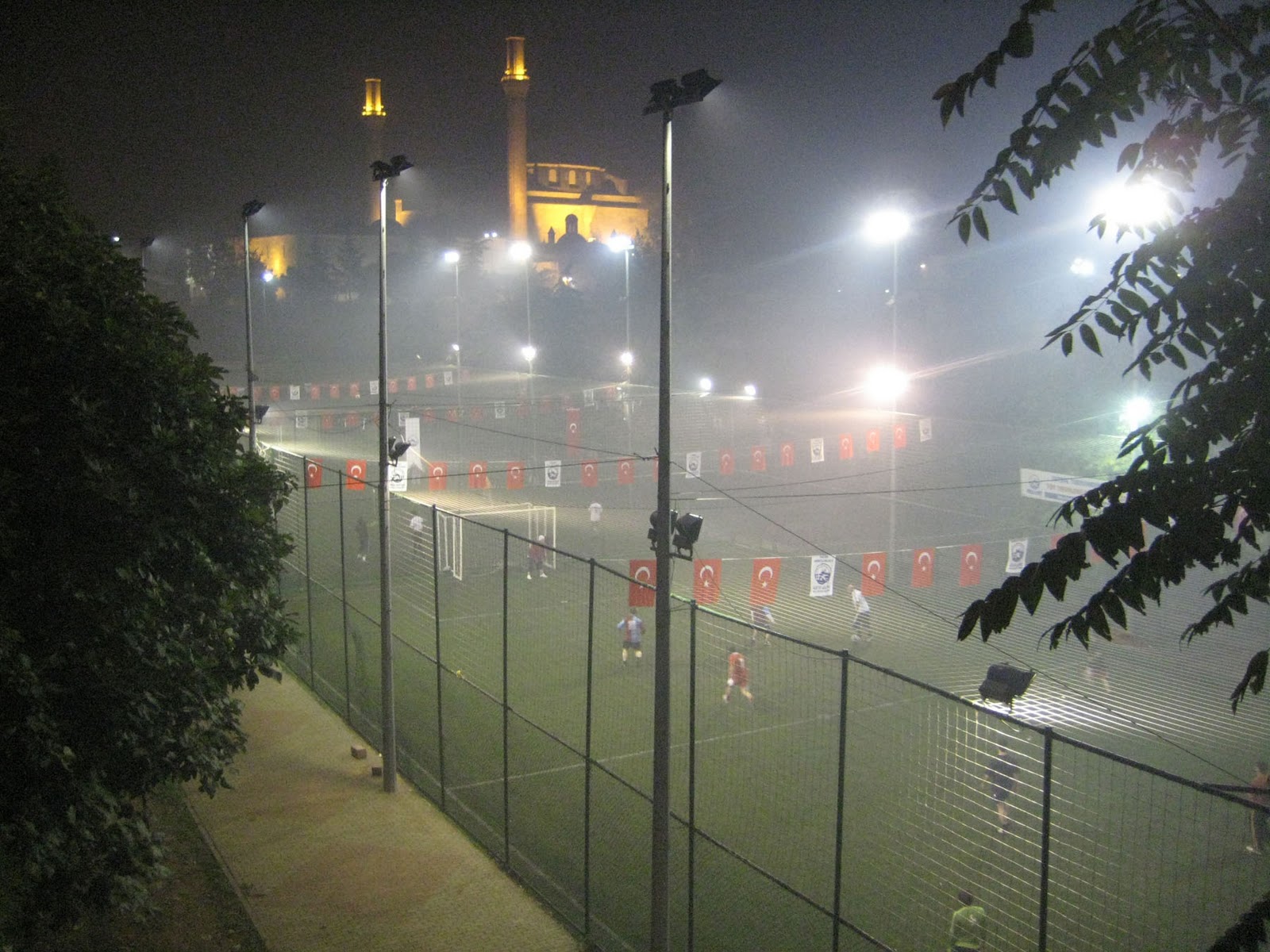
Soccer match in the fields on the top of our hill.


In our neighborhood, Fener. 


Our street, house is second on left. 

Wednesday, November 17, 2010

Bayram

Yesterday's Kurban Bayram celebration was wonderful, strange, bloody, and tiring. We went first to the garage next to our studios, where our friend, Ali, had told us neighbors would be killing and butchering sheep for the holiday. If you missed yesterday's entry, Bayram celebrates Abraham's willingness to sacrifice his son, and every family who can afford to do so kills and butchers a ram or bull. When we first heard about this, and the estimations of the millions of animals killed across the Muslim world on this single day, we were feeling like we were in truly foreign, and rather grisly, territory. But then we asked ourselves, is this really so different from the mass slaughter of turkeys for Thanksgiving next week? The overall annual meat consumption here is less than half of that in the US, and it is very unusual to have a meal centered around a big piece of meat. That in itself seems to make the Bayram feast a real celebration. 

As we watched the very skillful butchering of the sheep, we started thinking it was less strange, if you are a meat eater, to butcher your own meat, than to be as clueless as we were about the whole process. The biggest surprise (at least to Julia, who had never seen this before, while Shane had seen the butchering of deer as a kid) was that the body of the animal, inside and out, was so beautiful. The process also seemed very clean.

Part of the Bayram tradition is that some of the meat is given to neighbors, friends, and the poor. Early in the process of butchering the sheep, a woman came and ask for the gift of some of the organs. At the end, the man who owned the sheep gave us, the odd foreigners who had been sitting off to the side taking pictures, a prime cut. We are having friends over tonight to roast it.

We headed home with our hunk of roast only to be surprised to find that we had just missed another killing, this time a bull, and it happened right beside our house. Our friend Sarah saw the bull's last moments and reports that our kind neighbors sang to the bull and petted him before he was killed. The blood ran down a sheet of plastic into the sewer, helped along with water and brooms. Several men then began to butcher the bull. Without the use of a hoist to hang the carcass, we wondered how this was going to go. But the meat was cut apart right on top of the hide, never touching the ground, and the sections were laid on a plastic sheet for distribution. We watched the whole event from our kitchen windows. This was a real community effort, with cuts of meat going to dozens of families in the neighborhood. We received more gifts, this time the most amazing homemade baklava we've ever tasted, a savory onion and herb pastry,  and wonderful stuffed grape leaves. 

The atmosphere was so gentle and warm. Everyone is dressed up. The extremely sweet boy that lives across the street (the one from the language video) was dressed in the greatest little pin-striped suit. The old grandmas on our street had lots of visitors and were given many gifts of food. We gave our neighbors boxes of special holiday cookies from the local bakery, which included these luscious mini tart shells that are filled with chocolate ganache and topped with pieces of nut toffee. 

After the butchering of the bull was over, we felt tired. Never having seen anything quite like it before, the experience was intense and somewhat demanding. The lingering smell of the animal made us want to get out for some fresh air. We went our separate ways for the rest of the afternoon, Shane to the studio, Julia and Sarah for a long hike through the city.

All in all, our experience of Bayram was that of community, generosity, and a connection to the animals that we omnivores consume. We continue to be delighted by the welcome that we have here, and the warmth in general of Turkish people. We know that many of the photos below will be too graphic for some. Apologies. But, if you, like us, find yourself oddly interested in the deconstruction of farm animals, we are working on Bayaum, the movie, for next Monday. İyi Bayramlar, or Happy Bayrum.


A neighborhood grandma receiving a gift.


At the garage next to our studios.


Many turks hire a skilled butcher, rather than tackle the job themselves.


Rack of lamb. Some cuts, at least, we could recognize. 


Sheep's head is on the menu in lots of restaurants here. We ordered it once, by accident, and it was rather strong... 


The wool rolled up. 


Gifts from our neighbors: fabulous homemade baklava, lamb roast, stuffed grape leaves and borek (a type of savory pastry here, this one stuffed with onions and herbs) 


Bull's last moments of life. 


Washing away the blood. 


The view from our kitchen windows on Bayram. 


The green house on the right is our home. 


One of the sweet grandmas that live next door. 


The huge, multi-chambered stomach exposed. 


The meat was distributed among many families living on our street.


Monday, November 15, 2010

Holidays

Kurban Bayram, a major holiday throughout the Muslim world, begins today in Turkey. It celebrates the willingness of Abraham to sacrifice his son at god's command. The primary feature, in our minds, is the slaughter of thousands (and thousands) of sheep in remembrance of god's last minute substitution. So far, similar to Thanksgiving, except bigger animals feature in the feast. Every observant family that can afford to do so will sacrifice a sheep or cow. From what we understand, one third of the meat is kept for the family, one third is given to friends and neighbors, and one third is given to the poor. Apparently, we have front row seats. The parking garage next to our studios is going to serve as the neighborhood slaughterhouse. Most of Istanbul will be closed for the rest of the week. We were in the Grand Bazaar yesterday and were surprised to learn that it, too, would be closed for the week. Considering the deeply engrained mercantile history of this city (even the Emperors would trade on the side) this piece of news drove home the significance of Bayram. When, in the US, do malls close for more than a day or two for any holiday? More on Kurban Bayram soon.

The photos today are from another holiday, Republic Day, which was celebrated at the end of October. Very like the 4th of July, it is a one-day national holiday with fireworks and flags. We loved the thousands of banners/flags that popped up over the squares and long stretches of streets, creating tunnels of fluttering color and Atatürk faces. 


Turkish Language Primer


(This is a repeat of our earlier posting, with a functioning movie this time... hopefully!)

In honor the Pennsylvania Academy of Fine Arts students traveling to Istanbul next week, we made a Turkish language survival movie. In order of appearance, our commandeered instructors are: three fellow Fulbrighters, the talking heads from our computer language program, our studio building manager, two of the sweetest kids in the world, three neighborhood friends, and our studio landlord. A big teşekkür ederim (tay-shake-ore-red-dare-um - that is, thank you) to hosts Jordan Matthews, Paul Hartley and Aimee Genell.


Turkish Language Primer on you tube

If it isn't playing here, try:

http://www.youtube.com/watch?v=61zP_hcobq8


Sunday, November 14, 2010

Topkapı Palace, a first installment

Home to the Sultans for more than 400 years, Topkapı (top-cop-eh) Palace is sprawling grandeur. A collection of low, opulent buildings surrounding central garden courtyards, the Topkapı is more like a royal village than a European castle. We weren't as excited to see Topkapı as we were to see some of the other art and architectural sites of Istanbul, thinking it would be one long display of wealth without much of real visual interest to our tastes. As with many of our assumptions about this city, we were wrong again. There are the expected fruit-sized diamonds, hefty gold candlesticks, cursed daggers and ostentatious throne rooms, but the overall experience of the Palace is that of a very real place, full of small moments of beauty, gorgeous design and the mark of the many people who lived within its walls. 

At its peak, four thousand people resided within the Palace. Like a small city, it housed bakers, craftsman, soldiers, school teachers, politicos and artisans, as well as the often huge royal family and their staff. We have visited twice now, and have seen just a little more than half. On both visits, we went through the Harem, a winding complex of buildings with more than four hundred rooms. The Harem was the private residence of the Sultan, his family, concubines, consorts and eunuchs. Many of the photos below are from the Harem. Because these rooms were essentially private, serving the daily needs of children, wives and the Sultan's mother, it has a surprisingly intimate, home-like feeling.

Other highlights of our visits were the airy Library, the Imperial Council's Chamber, and the Hall of Holy Relics. The Library is right in the middle of the central garden, and would have been our choice, if we had been the Sultans, as the best place to relax with of cup of çay. The Imperial Council Chamber was where the ministers of state, council members and the Grand Vizier held meeting to fight out the best way to run the Empire. The Sultan did not participate in these deliberations directly, but sat in a private room adjacent to the Chamber, behind a gold grating. Here he would listen to the arguments, closing the sessions with a rap on the grating, at which time he would single out members to summon one by one for an audience. He then had the final word.

The Hall of Holy Relics houses sacred artifacts, including many items from Muhammad, among them his cloak, sword, letter, his foot print... and a tooth... and collection of beard hairs. The thirty or so beard hairs of the prophet are each separately enshrined in tiny and elaborate glass reliquaries, like pieces of the true cross. Beard hairs not withstanding, the most interesting part about this area of the museum is the chanting that fills these (still) sacred rooms. At first we thought it was an atmospheric recording, but the chant got louder, and we finally stepped into a light-filled stone room where an Imam was chanting verses from the Koran. Scrolling supertitles translate the verse into Turkish and English. The amazing thing is that this chant has been going on twenty-four hours a day since the sixteenth century(!)


We have more to see at Topkapı Palace, and know we will be going back several more times. Maybe on our next installment, we will have finally made it to the royal kitchens, the armory, and the large garden overlooking the Golden Horn, Bosphorus and the Sea of Mamara.


The Sultans private apartment in the Harem 


Entrance into the Harem 


The Harem entrance has this lovely pebble path, reportedly to give the Sultans horse a good footing.


In the Sultan's Mother's apartment

Marble drawers in the deep reveals around the windows in the Sultan's apartment. 


Looking our toward what was the large stone pool.


The exterior of the Sultan's apartment is elaborately tiled 


Sultan's bath. Water used to trickle over the scalloped wall. 


Honeycombed ceiling in the bath. This type of natural light ceiling is in many areas of the Harem. 


Sultan's toilet, very like some we have encountered (minus the gold and marble.) 


Council Chamber's with the Sultan's gold grate "listening hole."


In the Council Chambers 


Peristyle courtyard of the second garden.


A view to Topkapı from the Bosphorus